

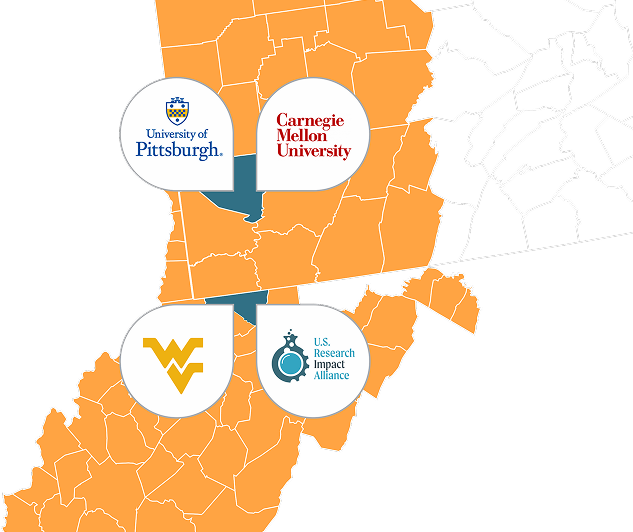
MORGANTOWN, W.Va. — The collaboration between WVU, the University of Pittsburgh and Carnegie Melon is being hailed as the key to securing a record-setting to develop an industrial energy innovation hub.

The National Science Foundation announced the grant awards Tuesday.
West Virginia University will lead the Resilient Energy Technology and Infrastructure Consortium (RETI) with the skilled researchers from the other two schools. The R-1 research institutions, along with 60 regional partners, will tackle the task with $161 million in grants from industry, workforce, philanthropy, state government, and community partners and an $160 million grant from the National Science Foundation (NSF).
WVU President Michael Benson said Wednesday on MetroNews “Talkline” the application process played out over a two-year period and required complete dedication from all the institutions and partners to earn this generational opportunity. Benson said work on the RETI will take shape over the next decade.
“This is a very material manifestation of what can happen when institutions that have like-minded goals and aspirations can work together to benefit western Pennsylvania and the entire state of West Virginia,” Benson said.
NSF RETI Engine CEO Erienne Olesh said West Virginia is very proud of its energy history but now it’s time to use that to forge a new future. She noted this opportunity comes at a critical time when electricity demand is on the rise and data center construction continues to pick up pace.
“We have an incredibly deep history that we are all very proud of in this region,” Olesh said Wednesday on “Talkline.” “With our energy legacy, the industrial manufacturing legacy, and the hub that has been borne out of this region.”

Benson said the site visit as part of the application process was originally scheduled for January, but a rash of winter weather postponed the visit, and the Morgantown visit was last in the process. The only group to offer a dollar-for-dollar match for the NSF funds was the WVU, Pitt, Carnegie Mellon trio.
“That collective $321 million, nobody else could say they had that amount,” Benson said. “That speaks to not only how good our application was, but how broad of an appeal it had to those partners that wanted to join.”
The group will be charged with finding a way to manage the increased energy demand at a time when environmental concerns are also increasing. Over the next ten years the RETI has the potential to drastically change the way we think about energy consumption.
“I think this idea that we were all rallying around the same vision and the same dream for what we could do and the course we could help ensure this region stays on is what enabled this partnership to stick through it over the last two years,” Olesh said.
Banson said being at the visit in the application process turned out to be a good thing. He has high praise for federal and state lawmakers, the NSF, the administrations of the University of Pittsburgh and Carnegie Mellon University, and the several dozen other partners that helped over the two-year process.
“So it turns out we were the last of the visits, number 12,” Benson said. “As the youngest of six kids, my mom would say the last is the best of all the gang; we really tried to put our best foot forward.”