

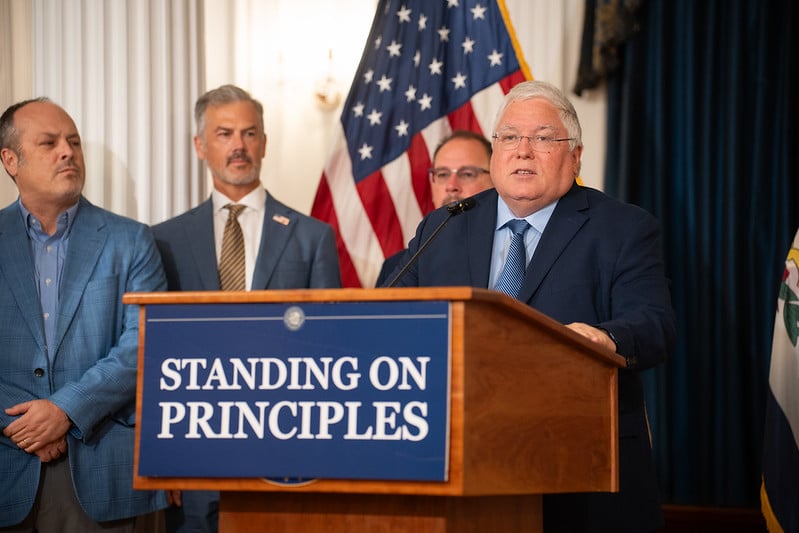
Gov. Patrick Morrisey’s administration and some members of the Legislature laid out broad principles for how West Virginia will deal with data centers.
Much the framework the governor laid out is intertwined with the Power Generation and Consumption Act that was passed into law in 2025.
The legislation is designed to attract massive high-impact tech and artificial intelligence data centers to the state. It also lays out how the tax base from data centers is divvied up.
Morrisey’s administration used the legislation as a basis to lay out a set of broad principles for dealing with data centers. The governor described it as a comprehensive 20-year strategy.

“Today, as the world stands on the cusp of a new digital and economic frontier, West Virginia is stepping forward once again to lead, not by repeating the mistakes of other states, but by implementing a proactive, 20-year development strategy on our terms,” Morrisey said.
Data centers are the big warehouses that house clusters of computer servers, data storage drives and network equipment. They store, process, and manage massive amounts of digital data and power cloud computing.
Data centers are enormous energy users, and that is only expected to grow as artificial intelligence and other computing innovations gain traction.
They are prolific in states like neighboring Virginia, but they are also controversial among residents because of their aesthetics and noise. They are not major employers but can contribute significantly to local property taxes.
Data centers are being developed and proposed across several regions in West Virginia, led by major projects in Berkeley, Putnam and Mason counties, alongside other proposals in Tucker, Mingo and Ohio counties.
Morrisey said the West Virginia Responsible Data Center Development Plan is built on seven core pillars.
Strategic planning: West Virginia is starting from scratch with zero active hyperscale facilities to carefully guide growth through a strict 20-year state-managed plan rather than reacting to unmanaged sprawl.
Direct tax cuts: Under the relatively new state law, 50% of the project revenue goes directly toward reducing and eliminating the state personal income tax. The remaining revenue is divided to support local schools, host counties, other West Virginia counties and local infrastructure.
Ratepayer protection: Developers must completely fund and procure their own power, legally shielding West Virginia residents and small businesses from utility rate increases.
Water protection: All standard environmental regulations remain fully intact, and the state is actively recruiting projects committed to next-generation water-efficient cooling like closed-loop systems.
Community control: A local advisory council of diverse experts will establish statewide standards for setbacks, noise mitigation, site security, and proximity to sensitive areas like schools and houses of worship.
Grid support: Facilities must operate under a demand-response model, utilizing on-site backup or reducing power during peak times to act as a net asset that protects grid reliability rather than straining it.
National security: Boosting domestic computing capacity within the state’s borders strengthens critical digital infrastructure and secures key data against strategic foreign adversaries like China.
“This shared framework gives us the exact blueprint we need to attract billions in private investment, create thousands of high-paying construction and technology jobs, lower taxes for our citizens, and revitalize economically distressed regions, all while preserving the wild and wonderful state we call home,” Morrisey said.

Amy Margolies, executive director of the Tucker United organization that has scrutinized a project in that area, expressed appreciation for state leaders recognizing the concerns about responsible data center development.
She said the need for improvement is clear.
“The current processes fail to ensure that communities can meaningfully inform data center developments. We need to see concrete, specific, and legally binding details for how microgrid and data center standards will be established and applied,” Margolies said.
“We also need details on the constituency and statutory role of the Data Center Advisory Council, including a dedicated role for non-elected community members.”
She said House Bill 2014, the big data center law, still has a range of issues “including a lack of transparency, ratepayer protections, water use details and local control. We are eager to hear the Governor’s plans to amend this bill to address the key principles he outlined in his responsible data center development plan.
“Once again, we would like to extend an invitation for the Governor to come to Tucker County to speak with us directly about our concerns and how they can be addressed.”

Emmett Pepper, policy director for Energy Efficient West Virginia, questioned some of the state government conclusions.
He asked, “If ‘data center developers must build, bring, or procure their own energy resources,’ then why is FirstEnergy asking for permission to start charging West Virginia ratepayers immediately to build a $2.5 billion power plant for data centers that may or may not ever come to fruition?
“To the extent that the legislature and governor are saying that they believe that the gas plant costs should not be passed along to ratepayers, that would be welcome news, but protections like that were not included in HB2014.”
Pepper said the legislature and governor need to go further than what is in HB2014 to protect ratepayers.
“They need to require utilities to have large load tariffs that protect ratepayers. They need to utilize some of the tax revenue that the state is taking from counties and municipalities and use it for ratepayer relief — things like helping avoid utility shutoffs, energy efficiency/weatherization of homes and small businesses, and helping people have more reliable service through battery backup.
“Those are all things that could have been in the final version of HB2014, but weren’t. It will be 2027 before we know it and it’s sad that, instead of announcing new ratepayer protections, our legislative leaders are pretending that the ratepayer protections in HB2014 are greater than they are.”