

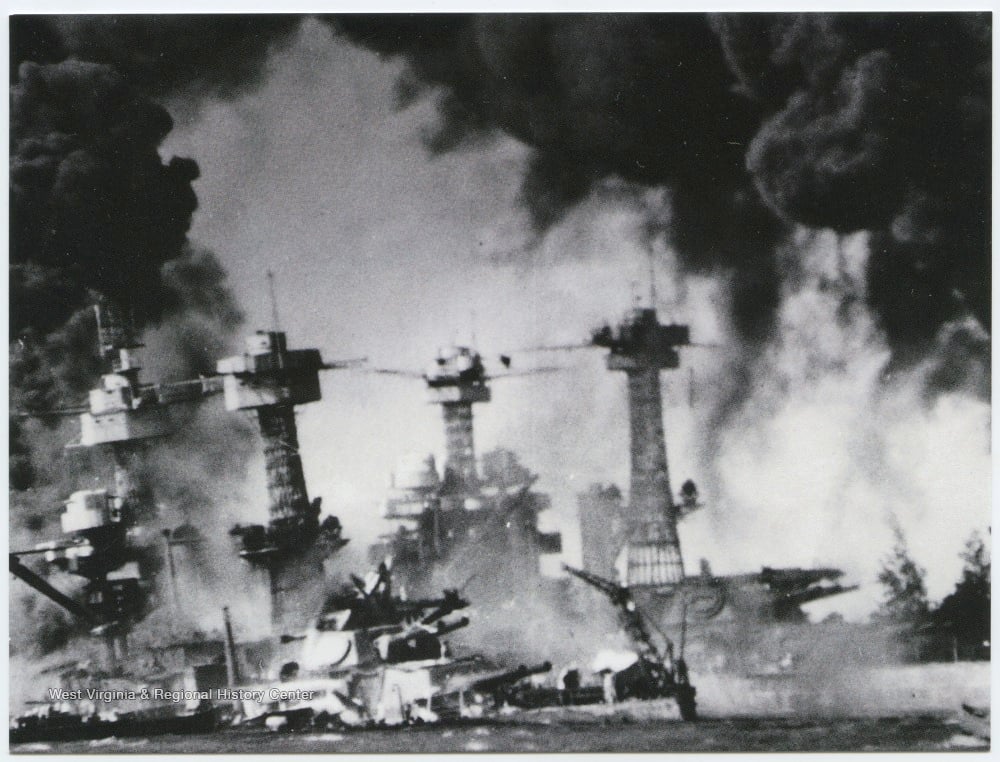
Doris “Dorie” Miller was a U.S. Navy cook and World War II hero known for his bravery on the U.S.S. West Virginia during the attack on Pearl Harbor.
On his own initiative, Miller loaded and manned an unattended anti-aircraft gun and fired at incoming Japanese planes. He was untrained but laid down effective fire and stopped firing when he ran out of ammunition and the ship began to sink.
He became the first Black recipient of the Navy Cross in 1942.
Miller continued his naval service and was killed in action aboard USS Liscome Bay in November 1943.
Miller was born in Waco, Texas, and grew up on a farm, played high school football, and dropped out to help support his family during the Great Depression.
He joined the U.S. Navy in September 1939 as a mess attendant, which was one of the few low-ranking jobs open to Black men at the time because of segregation. He was assigned Jan. 2, 1940, to the battleship West Virginia.
Because of his service and heroism on the ship bearing the state’s name, Miller has become sort of an adopted figure for West Virginia.
For example, Dorie Miller Park in Lewisburg was named in his honor in 1945. The park is in a historically Black community and directly behind the historic, formerly all-Black Bolling School and continues to reflect Miller’s legacy.
Miller’s heroism was on track to be honored on a grander scale the U.S. Navy officially announced on Jan. 20, 2020, Martin Luther King Jr. Day, that a nuclear-powered aircraft carrier under construction would be named the USS Doris Miller.
The milestone marked the first U.S. aircraft carrier named after a Black American and the first named in honor of an enlisted sailor. The aircraft carrier is planned for delivery and active service around February 2034.
Now it is less clear the honor will be carried out.
Within the past month, news reports by CNN, NBC and other outlets have focused on the possibility of renaming the aircraft carrier, potentially to an alterative that could honor President Trump.

West Virginia MetroNews asked U.S. Senator Shelley Moore Capito, R-W.Va., about her knowledge of the situation, whether she has a position on the matter and if the question would be appropriate to raise with acting Navy Secretary Hung Cao during upcoming confirmation hearings in the Senate.
Capito said she did not have particular insight about the details but responded by describing empathy with the family of Dorie Miller and making reference to her father, three-term West Virginia Gov. Arch Moore, who was a decorated U.S. Army infantry combat sergeant during World War II. Moore’s platoon was nearly destroyed by German forces, and Moore was severely wounded in the face and jaw.
“Quite frankly, as the daughter of a World War II veteran who I considered a hero, who almost gave his life for our country on the battlefield, I’m very, very inspired by messages, particularly from Doris Miller and the others, and particularly being honored in that way by having a battleship named for him,” Capito said.
“I think that’s right and proper, and I would that that’s what the Secretary of Navy decides to do.”
American Legion Post 100 in Monroe County has adopted a resolution urging that the Navy retain the name USS Doris Miller for aircraft carrier CVN-81.
The American Legion Post noted that the Navy has not publicly announced that the ship’s name has changed, but it has stopped referring to CVN-81 by its name and has not denied reports of the name change.

“Our Post believes that Doris Miller’s name belongs on CVN-81 because he earned that honor through courage, service and sacrifice,” said Scott Womack, commander of Post 100.
“This is not a partisan issue. It is about honoring an American sailor who demonstrated extraordinary courage under fire and gave his life in service to his country. We want to be on record early in the process rather than reacting to the change if it is made.”