

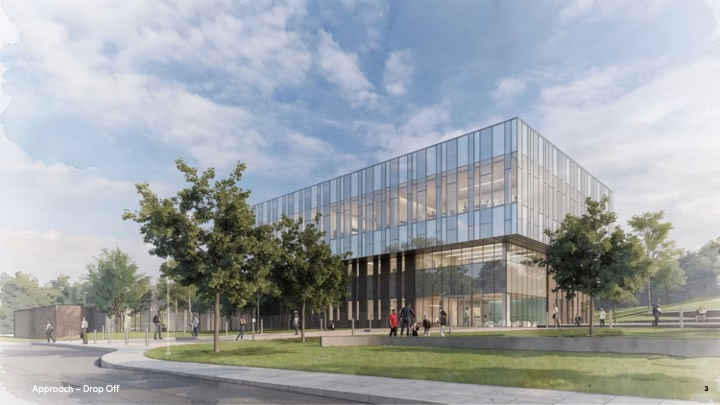
INSTITUTE, W.Va. — West Virginia State University is ready to get to work on its upcoming agriculture complex after receiving a $26.5 million grant through the US Department of Agriculture National Institute of Food and Agriculture’s Research Facilities Act Program.

The agriculture complex will house laboratory space for WVSU’s Purdy School of Agriculture, Food and Natural Resources, as well as the West Virginia Department of Agriculture.
“We may not be the largest institution in the country or in the state, but we have the talent, the expertise, the vision, and determination to compete with the very best,” WVSU President Ericke S. Cage said on Thursday.
The federal grant comes in addition to $50 million allocated to the project by the state of West Virginia in 2024. Construction on the approximately 40,000 square foot facility is expected to begin in early 2027 and conclude in 2029.
“We went to work. We took that investment, built upon it, and leveraged it into something truly extraordinary,” Cage said.
The university broke ground on the complex in 2024 as it worked to establish the agriculture school after previously being the only land-grant university in the state without one. Cage believes this is an opportunity for West Virginia State to make an impact well beyond campus.
“It will strengthen our capacity for agricultural research, education, and assistance to producers across the state. It will support critical work and food safety, microbiology, shelf life studies, and value-added agricultural development,” he said.
The partnership with the WV Department of Agriculture remains a significant part of the plans for the new building. Leadership on both sides hopes for a high level of productivity as a result of the shared space.
“Students and faculty work alongside WVDA to exchange ideas to help prepare the next generation of leaders for the agricultural workforce in our state and beyond,” Cage said.
Through a wide lens, Cage looks at this project as a rededication to WVSU’s original land-grant mission. He wants to fulfil the mandate that the university was originally created to pursue.
“This laboratory allows us to begin to continue to build upon that legacy in a really, really extraordinary way,” he said.
Cage noted that in addition to the new agriculture complex, the university is interested in farmland to utilize for further programs.