

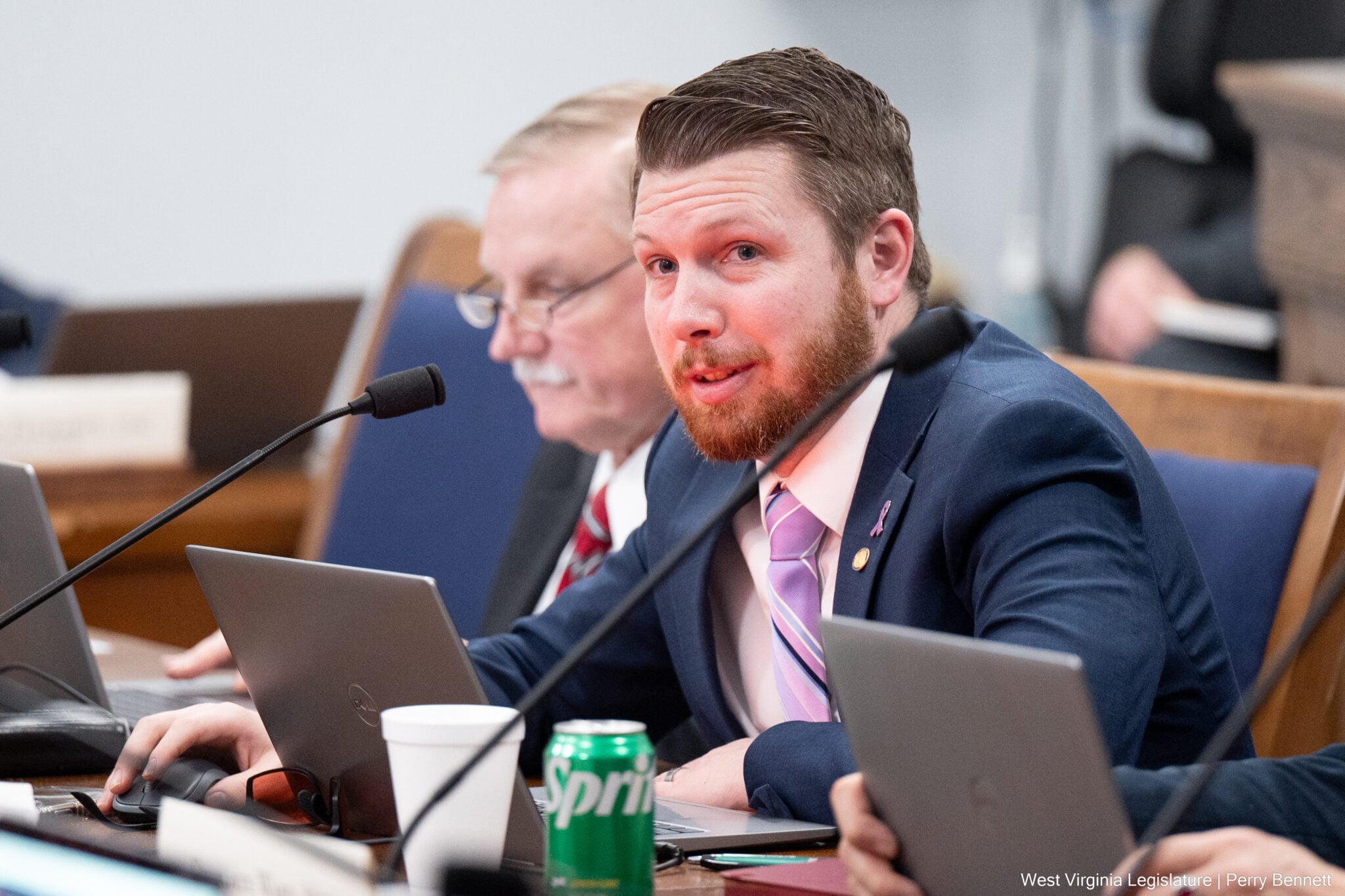
CHARLESTON, W.Va. — Two high-profile arrests of educators for alleged sexual misconduct against students has inspired a Kanawha County delegate to draft legislation on restricting contact between teachers and children.
Del. Tristan Leavitt, R-Kanawha, plans to introduce a bill inhibiting such communication. This comes after July’s arrest of former Fayette County delegate and schoolteacher Elliott Pritt, who recently pleaded guilty to one count of attempted production of child pornography.
Most recently, shockwaves rippled in Jackson County with the surfacing of allegations against now-former Ripley High School Athletics Director and Head Athletic Trainer Steven Lough. A preliminary hearing is set for Tuesday for Lough as he faces four criminal charges.

Leavitt said the state doesn’t have enough safeguards in place right now.
“As it stands right now, the only statewide thing that I’m aware of is in the State Board of Education’s regulations, and it just says it’s recommended that adult communication with students occur via one-way communication or district-sponsored applications,” Leavitt said. “I just think having uniformity will help districts that maybe don’t have a lot of time to look at all the aspects of this.”
According to Leavitt, Kentucky adopted a law last year that requires teachers to use mechanisms to make their contact with students more transparent for the district and parents. He said similar bills are being approved all across the student. In Kanawha County, the mechanism is the software Schoology.
“That prevents a situation where you have just one-on-one communication,” Leavitt said. “I think it’s also important to create consequences. Some educators have told me that this is a very strict rule in their county already. Some right here in Kanawha have told me that they are not aware of any rules that restrict their communications.”
Leavitt said having a rule is a great first step, but there also has to be strict penalties in place.
“I don’t know that parents recognize the peril whenever you have someone communicating just directly with their teacher or someone else, coach or someone who’s in a position of authority,” Leavitt said. “(It) can be entirely innocuous, obviously, and most of the time it’s just going to be to help the kids. But there’s some real risk there.”
In the case of Lough, text conversations between him and the 16-year-old student allegedly began after she was injured. Leavitt said education is extremely important, all the while not sacrificing the ordinary, safe relationships between teacher and student in school.
“You can keep that in the classroom, where it’s in the view of everyone else the other students. and when you need to communicate about homework or something being late or questions like that, there are definitely ways to do it,” Leavitt said. “But we’ve got to get away from the scenario of one-on-one texting, because that that is the number-one thing that any child predator is going to use to groom youth.”
Leavitt said the legislation would do everything in its power to restrict such illicit communications, but it can’t stop everything. That’s where harsh penalties come into play, he said.
“There’s no way that you can identify every different mechanism that someone might use,” Leavitt said. “I don’t think that any bill would go into that, but you just have to say ‘these are the approved methods and anything outside of that will have real consequences’ if someone is, again, having those direct communications.”
“I do think the consequences are significant,” Leavitt added. “If you have a way that there are actual teeth on it, and then you have a scenario where teachers who become aware of other teachers doing it have a duty to report and other things like that, that can increase the effectiveness of it.”