

A battle over a disputed seat in the West Virginia House of Delegates has taken another turn.

At issue is the seat originally won by Joseph de Soto, now a pre-trial defendant on home confinement on charges that he threatened the delegates who would have been his colleagues. De Soto, who was elected as a Republican, changed his affiliation to Democrat the day before his arrest.
After de Soto did not appear at the Capitol to be sworn in earlier this month, a majority of delegates voted for his seat to be vacated. Last week, Gov. Patrick Morrisey appointed Republican Ian Masters, a lawyer who is president of the gun rights organization Citizens Defense League, to take the seat.
Democrats have argued that the House majority’s process ran afoul of the state Constitution and also that state law and precedent say a Democrat should be named to the seat. Democrats asked the West Virginia Supreme Court for review, naming Morrisey and House Speaker Roger Hanshaw in their official roles.
Last week, an attorney representing Hanshaw filed a notice of automatic stay. The intent was to bring the case to a halt, citing a section of state code that provides a buffer against interference with attention to legislative duties. The time period covers 10 days before a legislative session, the duration of the session itself, and 30 days following adournment.
The filing for Hanshaw maintains the legislative session began Jan. 8, the one day of organization when most delegates swore their oaths and de Soto did not. Legislative action is currently on hiatus, but the regular session will pick up again Feb. 12 and go until April 12.
Now the state Democratic Party has made another move by filing again — this time by dropping the House speaker and keeping only the governor.
The filing by Democrats contends the House of Delegates acted inconsistently by vacating the seat won by de Soto since he was among seven elected delegates who were not present to take the oath of office on the organizational day earlier this month — but he was the only one knocked out in perpetuity.
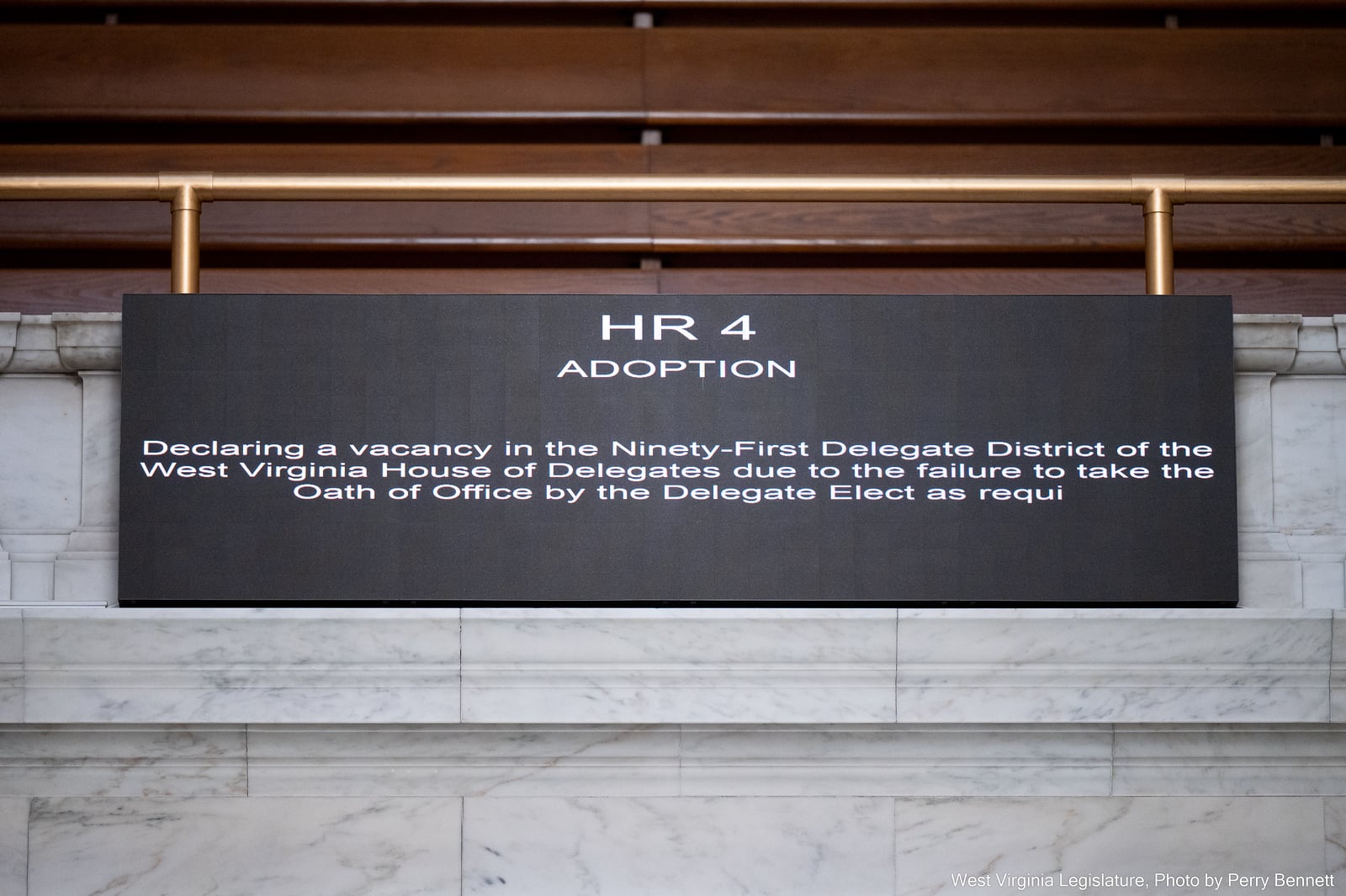
After de Soto was not seated, the House majority then went a step farther by introducing a resolution to declare the seat vacant.
The vacancy was declared on the grounds of Article XI, Section 16 of the West Virginia Constitution. A key portion of that section says: “Any member who shall refuse to take the oath herein prescribed, shall forfeit his seat.”
Debate among some delegates then focused on whether de Soto’s failure to take the oath of office because of the arrest and home confinement constitutes refusal to do so.
That’s a point that the Democratic Party has asked the state Supreme Court to resolve. A question being directed to the justices is “Whether the House of Delegates can declare vacant the seat of a duly elected, qualified, and ready-to-serve delegate for reasons related to misconduct.”
Speaking on MetroNews’ “Talkline,” House Minority Whip Shawn Fluharty, D-Ohio, described the process so far as a matter of ignoring the Constitution.

“The alleged conduct of Delegate de Soto, I believe, meets the obligations of the House to have him removed. He threatened our colleagues, and he has not been convicted of anything at this point, but the allegations are severe and they warrant removal,” Fluharty said.
“However, how you do that? You must follow the Constitution, and the Constitution is blatantly clear. Article Six, Chapter six, states that you have to actively refuse to take the oath of office. There has been zero evidence whatsoever put forward that Delegate de Soto has refused to take the oath.”
The proper remedy, Fluharty said, would have been to expel de Soto.
Another question has focused on the party of the delegate to be appointed to replace de Soto.
The rational of the Republican supermajority in the House is that because de Soto was never officially seated, the fact that he had registered as a Democrat weeks prior to this would have no bearing on the situation. So their resolution directed Republicans in Berkeley County to compile a list of replacements for de Soto.
The Democrats have been seeking clarity from the Supreme Court.
They are asking justices if a person holding the office immediately preceding a declared vacancy in a House of Delegate seat would include a person who was duly elected, assumed office on Dec. 1 following the election, as provided in West Virginia state code, but who had not yet taken the oath of office.
The Democrats point toward changes made to a section of state code governing vacancies in the state Legislature. Much of the precedent stems from the situation of former state Senator Daniel Hall, who was elected as a Democrat, switched to Republican and later left the Legislature.
“We already have clear law and a clear ruling by the Supreme Court previously in the Daniel Hall matter as to which party gets that seat when somebody decides to give up their own seat — is it the party they are elected to to begin with or is it the party they leave office with?
“And I believe it is blatantly clear by code and by enforcement from the Supreme Court that it’s the party that you leave office with, and that would be the situation here.”