

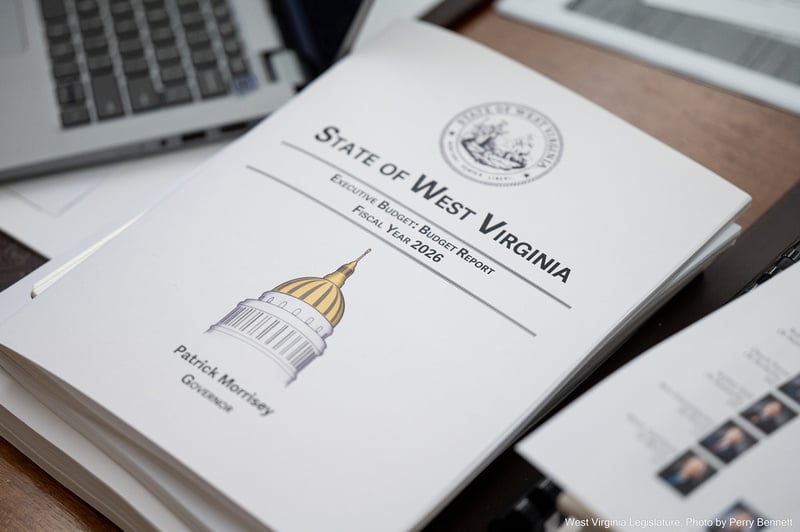
There are known knowns, unknown unknowns and then there’s the West Virginia state budget.
As West Virginia lawmakers work toward producing a budget for the coming fiscal year, there are a significant number of uncertainties.
One is increasing costs resulting from programs like insurance for public employees or the Hope Scholarship that provides financial support for families seeking educational avenues outside the public school system. Always a major driver of costs is the state-federal Medicaid program.
Another factor is fluctuating energy markets. Severance tax from coal and natural gas can be a major source of revenue for the state, but those markets are also notoriously fluid.
And then there are rapid changes occurring at the federal level — the potential for tariffs and counter-tariffs, the possibility of contracting federal agencies or reduced federal employment overall.
Gov. Patrick Morrisey’s administration proposed a $5.323 billion general revenue budget. The state Legislature has started the process of digging into the details, working toward a final budget for the fiscal year that starts July 1.
The Morrisey administration has said the state has a $400 million financial gap to fill.

“The governor’s expressed concerns about the long-term obligations, some of our long term obligations, and the extent to which they will balloon over the course of this fiscal year and upcoming fiscal years. He’s right about that there,” House Speaker Roger Hanshaw, R-Clay, said on MetroNews “Talkline.”
Hanshaw detailed some of the financial pressures the state is likely to face.
“Those include things like our Medicaid budget, our Public Employees Insurance Agency budget, the Hope Scholarship budget will expand. Those things are going to grow, and the governor’s just sounding an alarm to everyone about the extent to which they’re going to grow and that we need to take account of that.”
He noted that the state recently faced flush budgets, strengthened by factors like covid relief funding and the stimulus of programs like federal infrastructure spending. He said state officials tried to fact the reality that those conditions were temporary by aiming surplus funds at one-time investments.
“So for the past five years, when we’ve been in a surplus environment, our priorities have been things like infrastructure, paying down long term liabilities, knocking out as many one-time obligations as we can, to clear the deck for future legislators to be able to budget long term. Those surplus days are gone,” he said.
“Those environments are behind us now because the federal government’s not sending money in here the way it has during coronavirus. So it we’re back to normal budgeting days.”

Peter Shirley, deputy secretary for the West Virginia Department of Revenue, told state delegates how some of those factors are complicating state revenue predictions.
He spoke before the House Finance Committee.
The state office projects a 1.1% increase in revenue for fiscal 2026, with most revenue sources remaining flat or declining.
Shirley noted that West Virginia has approved major personal income tax cuts the past few years. “The Legislature passed a billion dollars in tax cuts, and that has an effect on our on our revenues,” he said.
Sales tax collections have increased, he said, in part because of rising costs of consumer goods. “Inflationary concerns are still a factor here. So sales tax is growing because the price of goods is going up. Also because people are consuming more, but you sort of get it from either direction,” he said.
Severance tax collections are always hard to predict, and state officials said the current environment is no different.
Natural gas production has grown, but prices have fluctuated, affecting severance tax collections.

“Some of the benefits we received two, three years ago were from the high gas and coal prices that lifted severance taxes over a billion dollars. They’ve since been cut more than half,” Revenue Secretary Eric Nelson told the House Finance Committee.
The state’s coal production has declined by 49.8% since 2008, officials said.
“In 2023 we exported about 35% of our coal,” Shirley said. “So the export market is important. Is important to us. About a third of our coal does go out of the country, and our biggest trading partners in order, are India, the Netherlands, Japan, Brazil, South Korea, and then China.”
Shirley described uncertainty surrounding federal policy, including the effects of potential or enacted tariffs. “So at the moment, we don’t know what tariff policy is going to end up looking like,” he said.
And he described uncertainty about the extension of Trump-era federal tax cuts.
“Will any of them expire? Will some of them be enhanced from what they were back when they were originally passed in 2017? We don’t know. And so this forecast and all of our revenue estimates for now assume the status quo, because we don’t know what the future may hold.”