

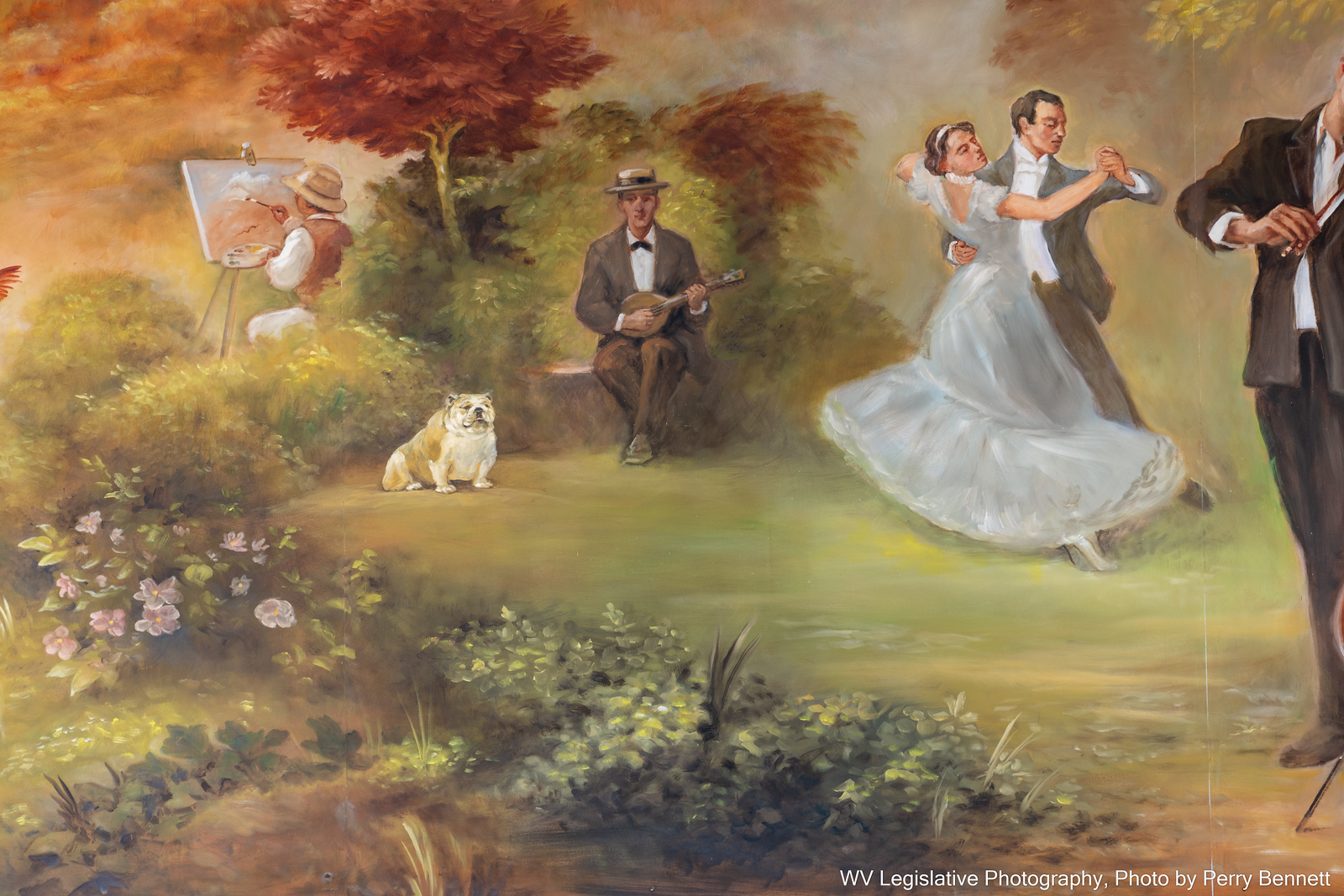
A lawsuit has been settled over a state Capitol mural depicting scenes that include an image of the former governor’s well-known dog.
The image depicted on a knoll among dancers and musicians looks a lot like “Babydog.” Much of the legal conflict, though, focused on whether the murals went forward without adequate public comment or oversight.
The lawsuit against the West Virginia Capitol Building Commission and former arts secretary Randall Reid-Smith had claimed the mural in the Rotunda was unlawfully bid and that the publicly-stated reasons for proceeding with the project were stretched beyond the limits of credulity.
The settlement order, to be presented to Kanawha Circuit Judge Dave Hardy stipulates that the commission must hold a special public meeting to review and ratify the murals and contracts, ensuring compliance with public notice and comment requirements.
Under that, anyone would be free to address the commission and ask that the whole project be rejected, that the dog image be removed or the murals approved as installed. The final decision in the public process would lie with the Capitol Building Commission.
Furthermore, as part of the compromise, the defendants are ordered to pay the plaintiffs $18,500 for attorney fees and costs, leading to the dismissal of all claims with prejudice.
“Further litigation of this issue will result in uncertainty regarding the mural lunettes and pendentives placed in the central rotunda of the Capitol in 2024 and subject the parties to the expenditure of substantial amounts of taxpayer money for litigation,” according to the settlement filing.
The lawsuit was filed last year by attorney Harvey Peyton, a regular MetroNews legal analyst, on behalf of Tom Acosta, an artist who was among the original bidders to perform the mural work in 2010.
Another plaintiff was West Virginia resident Gregory Morris, whose participation in the lawsuit is as a citizen objecting to requirements for open meetings and competitive bidding.
The dispute unfolded after an image of the governor’s beloved pet, Babydog, was unveiled in June, 2024, as part of a mural of West Virginia history and culture at the state Capitol Rotunda. The bulldog can be seen on a knoll with Seneca Rocks in the background and near images of an artist, a couple dancing and some musicians.
Then-Gov. Jim Justice has said he had no role in the decisions surrounding the depiction of his high-profile dog in a taxpayer-funded mural at the state’s most prominent public building, but he applauded it.

The murals were characterized initially as a project to “depict iconic state scenes and landmarks” in line with the vision of famed Capitol architect Cass Gilbert. An initial image of the Seneca Rocks scene did not include a dog of any kind.
Reid-Smith, the arts secretary for many years, regularly described context of Gilbert’s unfinished vision for the Capitol, suggesting features like murals could not be completed originally because of their cost.
Reid-Smith usually said the Capitol Building Commission — the appointed board that reviews and approves or rejects all plans for substantial physical changes to the grounds and buildings of the State Capitol complex — engaged in consideration beginning in 2009 and approval of starting the process on April 14, 2010.
Reid-Smith did not describe further involvement of the Capitol Building Commission, which now has different members. The dog whose likeness is portrayed was born in 2019, a decade after the Capitol Building Commission provided initial approval of the mural project.
The secretary said a different group of executive branch representatives reviewed the specific mural scenes: himself, state Museums Director Charles Morris, Administration Secretary Mark Scott, senior adviser Ann Urling and Rebecca Blaine, director of intergovernmental affairs.
That group, Reid-Smith has said, unanimously concluded the mural should include a dog — and further concluded that dog should look just like the current governor’s. There is no indication that group had meetings open to the public.
The lawsuit contended that Reid-Smith maneuvered to have the project declared “impossible to bid,” steered around the open process of the current Capitol Building Commission. The lawsuit indicated he led 16 meetings of the Capitol Building Commission with no disclosure or discussion of the mural approval process.
Then, the lawsuit contended, Reid-Smith inappropriately directed activities of the unofficial committee that made the final call to include the image of the well-known dog.