

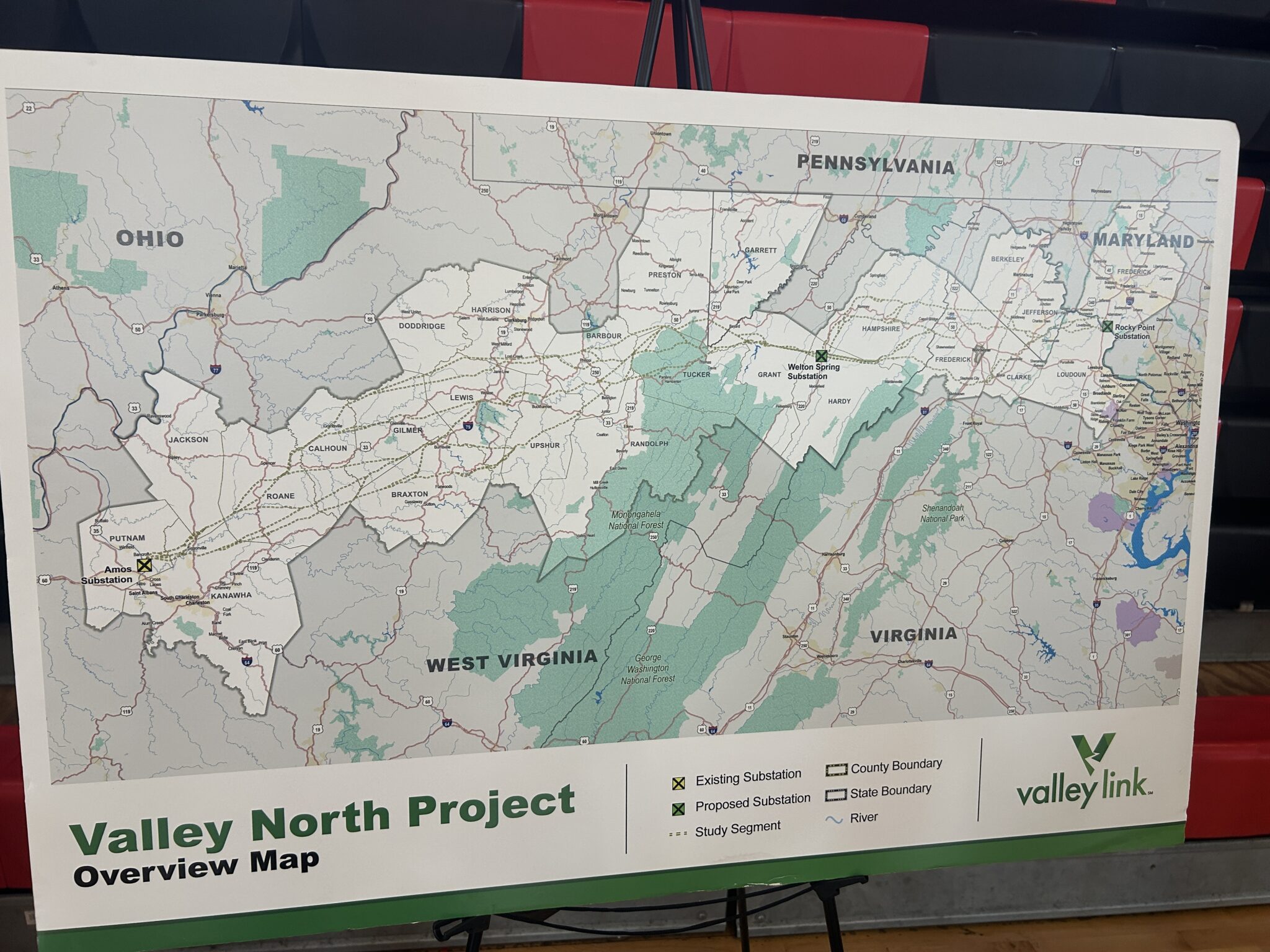
SISSONVILLE, W.Va. — Kanawha County residents got an opportunity to learn and ask questions about the massive proposed 260-mile Valley North transmission line from Putnam County to Frederick County, Maryland.
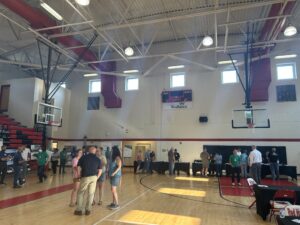
Valley Link hosted an open house at Sissonville Middle School Tuesday night. Sissonville was one of Valley Link’s 23 stops throughout the communities that would be affected by the line. Jefferson County residents got a look at the plans last month.
The Valley Link North Project would stretch through 20 West Virginia counties, with 260 miles of 765-kilovolt (kV) transmission lines. The project is a joint venture among three companies: AEP subsidiary Transource Energy, FirstEnergy Transmission, and Virginia-based Dominion Energy.
The line is proposed to begin at the John Amos Power Plant and end at a proposed Rocky Point Substation in Maryland. The proposed Welton Spring Substation in Hardy County, W.Va, would also be part of the Valley Link project.
Valley Link spokesperson George Porter told MetroNews that no routes have been set in stone for the line. This 23-stop process throughout the proposed route enables officials to hear from residents and make adjustments based on that feedback.
“This is the first step of that communication because we’re going to have months and months of this,” Porter said. “This is just step one. Once we get these routes and we define them, we’re going to come back in November and do this all over again and every county again to say, ‘hey, we took your information back in June and July. Here’s what we came up with. What do you think of this?'”
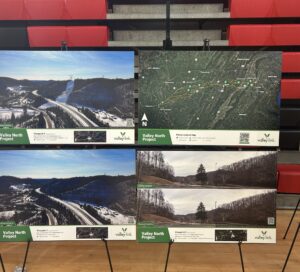
After that, Porter said the final decisions on routes would be made. Valley Link would then file with the West Virginia, Maryland, and Virginia Public Service Commissions next year. Porter said approval from the commissions typically takes a year.
If approval is received, Valley Link eyes a start to construction in 2029. Porter said they would plan to complete the project within a two-year span after construction begins. He said they would turn to local contractors to accomplish that goal, estimating that thousands of construction jobs would be created.
Sissonville resident Pam Curry said her home is not directly impacted by the proposed Valley Link line. However, she said some good friends may see the line go through their front yard, disrupting their gardens and land.
“I’ve talked to any number of people, who are talking about how they have multigenerational farmland they’ve been taking care of for a long time,” Curry said. “They’re really distressed about what’s happening to their land, to their neighbors, and the state.”
Another Sissonville-area resident, Nathan Marion, said he learned that there were lots of proposed routes, rather than just a handful. He wondered how much noise the transmission line would generate.
“The biggest concern I have is the noise,” Marion said. “I live in the country. It’s nice and quiet in evenings. With one of the proposed routes, it’ll be really near my house. Sitting outside at evenings, I don’t want to be hearing a bunch of static and electricity.”
Porter said there would be impacts on ratepayers’ bills with this project. He said transmission projects are based off PJM Interconnection, the regional transmission organization that monitors the electricity grid. He said any project, upon completion, requires residents in the area — in this case, West Virginia, Maryland, and Virginia — to pay for a portion of the work.
“It’s usually pennies on the dollars, it’s not as though this project will go (only) to the Sissonville community,” Porter said. “Everyone in these communities will have to pay this because they’re all getting the benefit from receiving reliable power from this new transmission line.”
Curry said residents are concerned that the project is meant for out-of-state corporations. She said the line would disrupt private land, take away environmental sustainability from West Virginians, all to serve Virginia’s grid. She highlighted that West Virginia has historically seen a “constant drain” of resources and people by out-of-state industries. Additionally, she was concerned about the electric rate increases as a result of the project.
“All of it together is just an incredible exploitation of West Virginia, and an insult to those of us who live here and are trying to make the place the best that we can be,” Curry said.
Community organizer Jodi Urbanic set up a table outside of the school to encourage residents to sign a petition against the project. She said community members have serious concerns about the project’s impacts on the environment and on landowners.
“I just want people to understand that they have rights as residents of Kanawha County, and they can put up ‘No Trespassing’ signs,” Urbanic said. “They can sign petitions to be against the proposed transmission lines. The more petition signers we have, the better.”
Urbanic said there are “Stop Valley Link” Facebook groups for each of the 20 counties that would be affected. Additionally, she said WATI — West Virginians Against Transmission Injustice — have helped with petitions and action in protest of the line.
“None of the electricity stays in West Virginia, so it does not help our grid at all,” Urbanic said. “It’s like a extension cord for data centers in Maryland and Virginia. So it doesn’t prop up our electricity at all. There’s no way that I see this as beneficial for West Virginia.”
Porter said PJM identified that the region needed more lines to prepare for the coming power demands. He said Valley Link began preparations for the line before data centers even became a hot-button issue. The line was not made specifically for out-of-state data centers, he explained. Rather, he said it is meant to attract manufacturing, healthcare, and automotive industries from around the country to invest.
“We’re trying to provide that power, which is going to benefit our West Virginia customers because having that power in place allows large companies to come here,” Porter said. “Which builds economic development, which brings more and more development to our state.”
There has been no shortage of participation in the 21 open houses so far, Porter noted.
“We’ve had over 5,000 people come through the doors, and we’ve received over 3,000 comments,” Porter said. “So that’s going to take some time to kind of go through them all, and we’re going to go through every single one of them. Because if you take time to show up and you tell us what’s important to you, it’s important to us to make sure we understand that, make sure we see that, make sure we document that.”
The last two open houses are planned for Jackson and Putnam counties Wednesday. The Jackson County open house will be held at the Greene Center in Kenna, with Putnam County’s event at Poca High School.
Both open houses will run from 4 p.m. until 7:30 p.m.