

CLARKSBURG, W.Va. — The new leader of Harrison County Schools has outlined the next steps for the system as it tries to right size its finances.

New superintendent Dr. Sheena Van Meter, who replaced the retiring Dora Stutler in the role, addressed the county board of education Tuesday with a thorough presentation of the current financial situation and what next steps are going forward. This summer, the state Board of Education seized partial control over Harrison County Schools over concerns of the school system spending $16 million of its reserves over a two-year period.
The $16 million spending number over a two-year period relates to the 2026 and 2027 fiscal years. Harrison County Board of Education President Frank Devono Jr. said on MetroNews “Talkline” in July that the county had $17.5 million remaining in that reserve account at the conclusion of FY 2026.
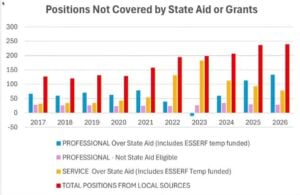
Van Meter said that Harrison County Schools have made cuts since the end of the 2025-26 school year. However, she said the school system is still well over the state allotment.
“After the abolishment of the vacated positions that, since last year we have been eliminating as we can, we currently employ approximately 153 professional and 71 service personnel in excess of positions funded by the state,” Van Meter said. “That’s talking about what the state funds, that doesn’t include what the levy funds or other sources; that’s what the state funds.”
Those numbers are down from 161 professional positions and 78 service personnel roles during 2025-26. Van Meter said that Harrison County was in the top three of counties spending over the state’s School Aid Funding Formula. She said that spending doesn’t match enrollment trends.
“Last year, statewide, only two counties exceeded the formula by more than Harrison County, which was 239 total over the formula,” Van Meter said. “Preliminary numbers indicate that enrollment in Harrison County has declined more than 200 students for the 2027 school year; the school year that we’re in right now.”
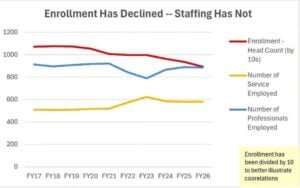
The enrollment numbers for this fall will be certified by the end of November, Van Meter reported. She said that Harrison County has grown to rely on “locally funded positions” year after year. Those positions need levy funds, local revenue, or other sources. She said that’s not a sustainable approach.
“Essentially, if it’s not covered by state aid or grants, it’s like paying your mortgage out of your savings account,” Van Meter said. “You can do it once, but you can’t do it forever. That’s the key takeaway for that one.”
While the Third Grade Success Act, otherwise known as House Bill 3035, has caused some changes, Van Meter said that’s the “only significant change since 1993” with the school aid funding formula. She said while fewer students are attending Harrison County Schools, the school system’s employment numbers have remained about the same.
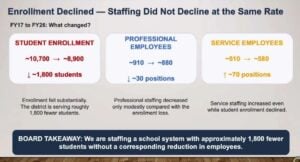
“In the last ten years, 1,800 student population decline (from around 10,700 to around 8,900) for our enrollment,” Van Meter said. “And then you can see along with that, we’re down 30 professional positions (from approximately 910 to approximately 880) and we’re up 70 service positions (from roughly 510 to roughly 580).”
According to Van Meter’s presentation, the current personnel and benefit costs surpass the levy’s coverage by $12.7 million. Van Mater said she’ll embark on determining personnel recommendations for the Harrison County Board of Education.
She said she’ll be reviewing the following considerations:
– Cutting positions that open because of transfers, resignations, or retirement.
– Evaluate if school closures are necessary based on enrollment numbers.
– Assessment of schedule options for personnel to “maximize instructor utilization.”
– See if some positions can be combined after review.
– Examine which bus routes can be reduced or combined.
Van Meter is required to present those recommendations before May 1 next year, a deadline set by the state code.
She pointed out that the state’s funding formula is at the heart of these decisions.
“It’s not something that Harrison County Board has done, this is not something that the West Virginia Department of Education is doing, this is a legislative issue,” Van Meter said. “This is something that we’re going to have to continue to fight really hard for in Charleston. We’re going to have to work with our elected officials and explain the importance of public education and the things we need to keep our schools operating top notch and give kids everything that kids need.”