

Every fall somebody asks the same question: when does the first snow usually show up in West Virginia?
It’s a fair one. Leaves are still hanging on in a lot of places, football season is in full swing, and Halloween candy is already on the shelves. Snow feels like a December problem. The record books say otherwise.
We’re talking about measurable snow here — at least a tenth of an inch on the ground at the official climate sites. A few flakes in the air that melt on the sidewalk don’t count. Once you stick to that standard, the earliest dates for some of our bigger towns are eye-openers.
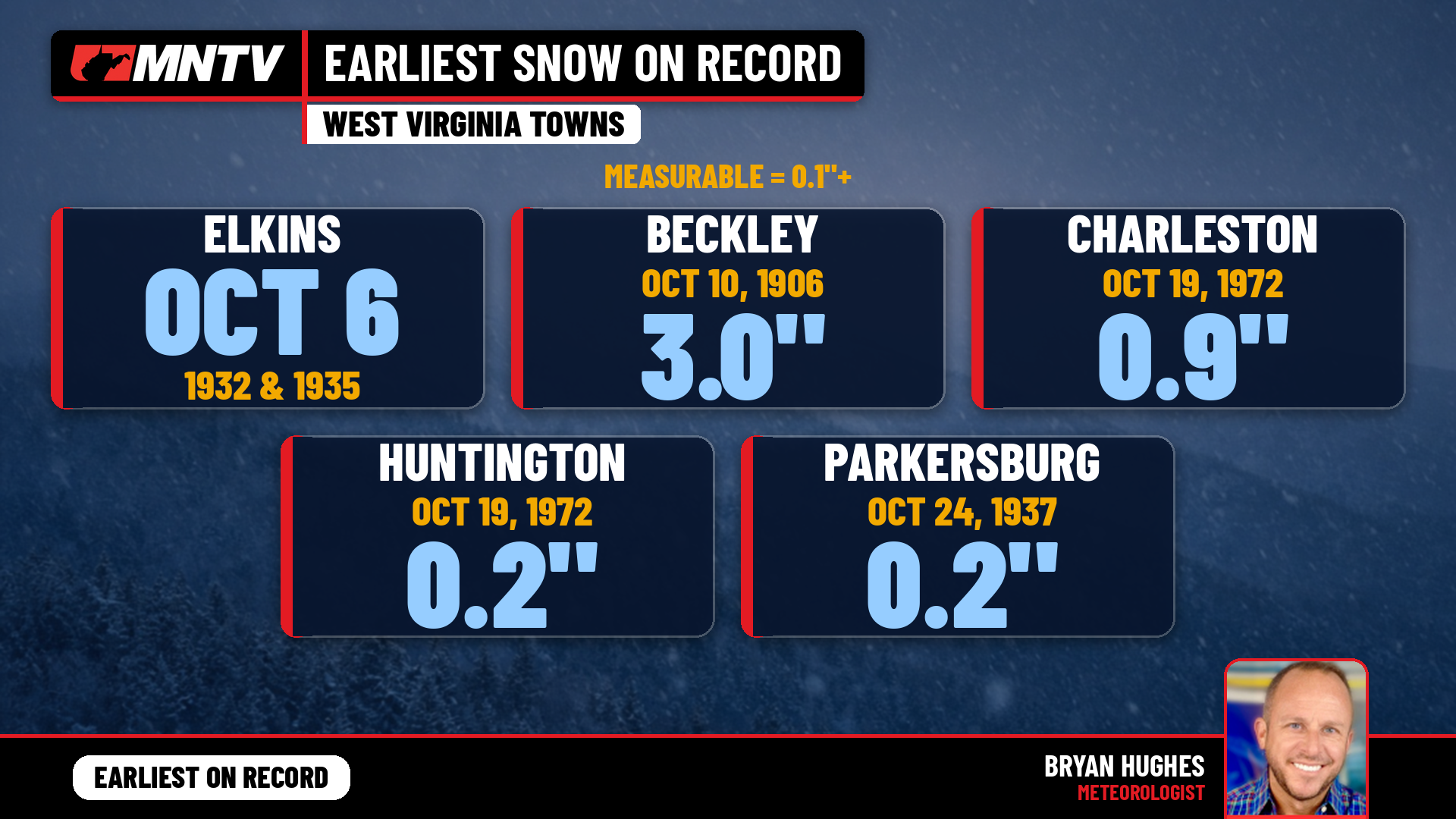
The earliest measurable snow on the books
Start in the mountains, where winter always gets a head start.
Elkins has seen measurable snow as early as October 6. It happened in 1932 with an inch, and again in 1935 with 1.5 inches. That October 6 mark is the earliest calendar date among the towns we’re looking at today.
Beckley isn’t far behind. The long-term climate record there shows 3.0 inches on October 10, 1906. That’s not a dusting. That’s a real early-season snow that would have stuck around on the hillsides.
Down in the valleys, the bar is a little later — but not by as much as you’d guess.
Charleston (Yeager Airport) and Huntington (Tri-State Airport) share the same earliest date: October 19, 1972. Charleston picked up 0.9 inches that day. Huntington got 0.2 inches. Same cold shot, different amounts depending on where you were.
Parkersburg‘s earliest measurable snow in the long-term record is October 24, 1937, at 0.2 inches.
So if you’re keeping score: Elkins in early October, Beckley a few days later, the Kanawha and Ohio valleys by mid-to-late October. Those are the earliest measurable snowfalls on record at those sites — not what happens most years, but what has happened.
What “usual” looks like
Those earliest dates are the outliers. The more useful question for planning a coat purchase or a fall hike is when the first measurable snow typically arrives.
Based on the last three decades of daily climate records (1991–2020), the median first measurable snow at Elkins lands around November 12. At Charleston, it’s closer to November 23.
In plain English: half the winters at Elkins have already seen at least a tenth of an inch by mid-November. In Charleston, you’re often still waiting until the week of Thanksgiving. A fast start can shove those dates into early November. A slow one can push them into December.
The National Weather Service in Charleston notes that snow across our area is most common in December through February, but it isn’t unusual for measurable snow to show up in October — or hang on into April or May in the higher country. Elevation does a lot of the work. The Alleghenies cool off earlier and hold onto cold shots that the Ohio River towns shrug off.
Why October snow feels so strange
When it does snow in October, it usually feels wrong for a reason. The ground is still warm. Leaves are still on the trees. A tenth of an inch can look like nothing in town and still dust the ridges. That’s why those earliest records matter for context more than for panic: they’ve happened, they’re rare, and they remind us winter doesn’t wait for the calendar.
October 1972 is a good example for the lowlands. Charleston and Huntington both logged their earliest measurable snow that same mid-October day. It wasn’t a blizzard. It was just early — early enough that more than fifty years later, nothing has beaten it at those airports.
Beckley’s 1906 snow is the opposite kind of story: three inches in the first third of October. That’s the kind of event that sticks in the climate record because it was both early and meaningful.
Looking ahead this week
We’re not trying to scare anybody into digging out the shovel on October 26. Most years, the first real snow for much of West Virginia still waits until November. The mountains lean earlier; the valleys lean later. That’s the normal rhythm.
What I do want to do is set the table. Later this week we’ll take a separate look at something a lot of folks ask about this time of year: snow on Halloween. Have we had it? Where? How much? That’s its own story — and it’s coming midweek.
For today, the takeaway is simpler. West Virginia’s first measurable snow can arrive earlier than the calendar feels ready for, especially from Beckley east into the high country. Elkins has seen it on October 6. Charleston’s earliest is October 19. Typical first snow still clusters in mid-to-late November for most of us.
Have you ever woken up to snow in October here? Drop the year and the town in the comments — I’d love to hear the early ones you still remember.
Sources: National Weather Service Charleston climate records (October top-ten snowfall by station); NOAA NCEI GHCN-Daily station data. Median first-snow dates are derived from 1991–2020 daily records; NOAA does not publish official first-snow-date normals.