

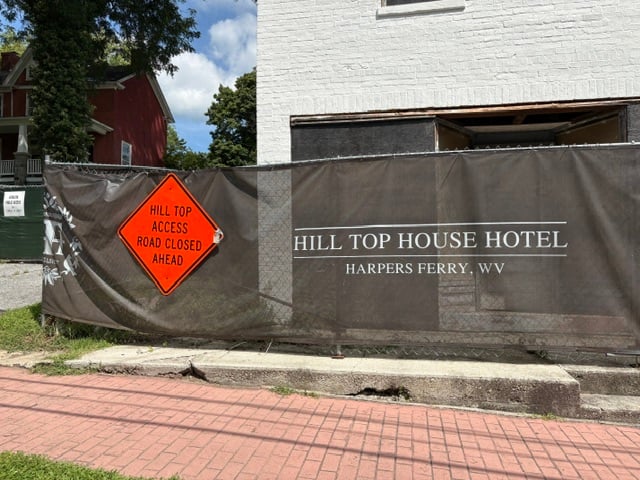
Justices on the state Supreme Court declined to order lower courts to reexamine the lawfulness of a development district where the highest-profile project, Hill Top House Hotel in Harpers Ferry, has yet to blossom.
At issue was law establishing tourism development zones where new or expanded projects may be virtually immunized from local regulations, including municipal zoning and land use ordinances, municipal regulations on the sale of liquor, beer, or wine and municipal building codes.
It was being challenged by several Harpers Ferry residents.
Justice William Wooton wrote the majority opinion, finding no error in how lower courts considered the development district situation. Chief Justice Haley Bunn dissented. Justice Charles Trump, who was a state senator when the bill was passed, recused himself and Circuit Judge D. Andrew McMunn of Harrison County sat in.
In 2020, lawmakers passed the West Virginia Tourism Development District Act, directly tied to the long contested reconstruction of the historic Hill Top House Hotel in Harpers Ferry.
Last month, justices on the state Supreme Court considered arguments over whether the statute improperly strips local regulatory authority and voting power to benefit a single private luxury hotel project.
The legislation allowed the West Virginia Department of Economic Development to establish up to five “Tourism Development Districts” for companies investing in big projects in the smallest towns. The act exempts the projects from municipal authority and regulation.
The legislation came about after years of wrangling over a proposal by SWaN Investors to restore the Hill Top House Hotel, which first opened in 1889, burned down twice and reopened twice and continued until 2007. To now, Hill Top House is the only project approved as a tourism development district.
The Hill Top House Hotel renovation has been envisioned as a $150 million destination with world class amenities in the historic gateway to West Virginia.
There’s not much sign of progress. Most of the hotel property is surrounded by metal fencing. In Harpers Ferry, officials continue to ask what is going on with the hotel, which is a regular town council agenda item.
The lawsuit over the state’s role was brought by five residents of Harpers Ferry.
They contend that by restricting Tourism Development District designations to a maximum of five towns under 2,000 in population with projects costing at least $25 million, the Legislature created an arbitrarily narrow classification.
They allege the policy was written specifically to benefit a single private developer, SWaN Hill Top Partners, LLC. And they argue that the $25 million minimum requirement and the five-town/2,000-population limit bear no rational relationship to the state’s goal of promoting tourism across West Virginia.
The plaintiffs asked the Supreme Court justices to reverse lower court dismissals in Kanawha Circuit Court and the Intermediate Court of Appeals and remand the case for a full trial.
“After reviewing the Act, we reject the petitioners’ argument. The Act does not target specific people or entities, and it does not establish any one project for success to the detriment of others,” Wooton wrote.
“The Act merely encourages tourism development projects in small municipalities by granting benefits to up to five large projects that private entities want to locate in small communities.”
The state commerce department, the agency being sued, was represented by the state Attorney General’s office. Although no other applications have come through so far, attorneys for the state have said the policy could be appealing for developments in small towns like Anstead, Hawks Nest, Bramwell or Shepherdstown.
In Harpers Ferry, officials continue to ask what is going on with the hotel, which is a regular town council agenda item.
Chief Justice Bunn dissented because, she said, the standing of the Harpers Ferry petitioners should have been further explored in the lower courts.
A remand of this case to the circuit court would have allowed the parties the opportunity to develop facts that potentially would give rise to a particularized injury on the part of the plaintiffs sufficient to confer standing,” she wrote.
“The Court should not address the merits of this appeal without fully analyzing the question as to whether the Petitioners have a particularized injury and therefore standing, without which neither this Court nor the lower courts have jurisdiction.”